

The Weight of Living
The Things We Carry and the Price We Pay

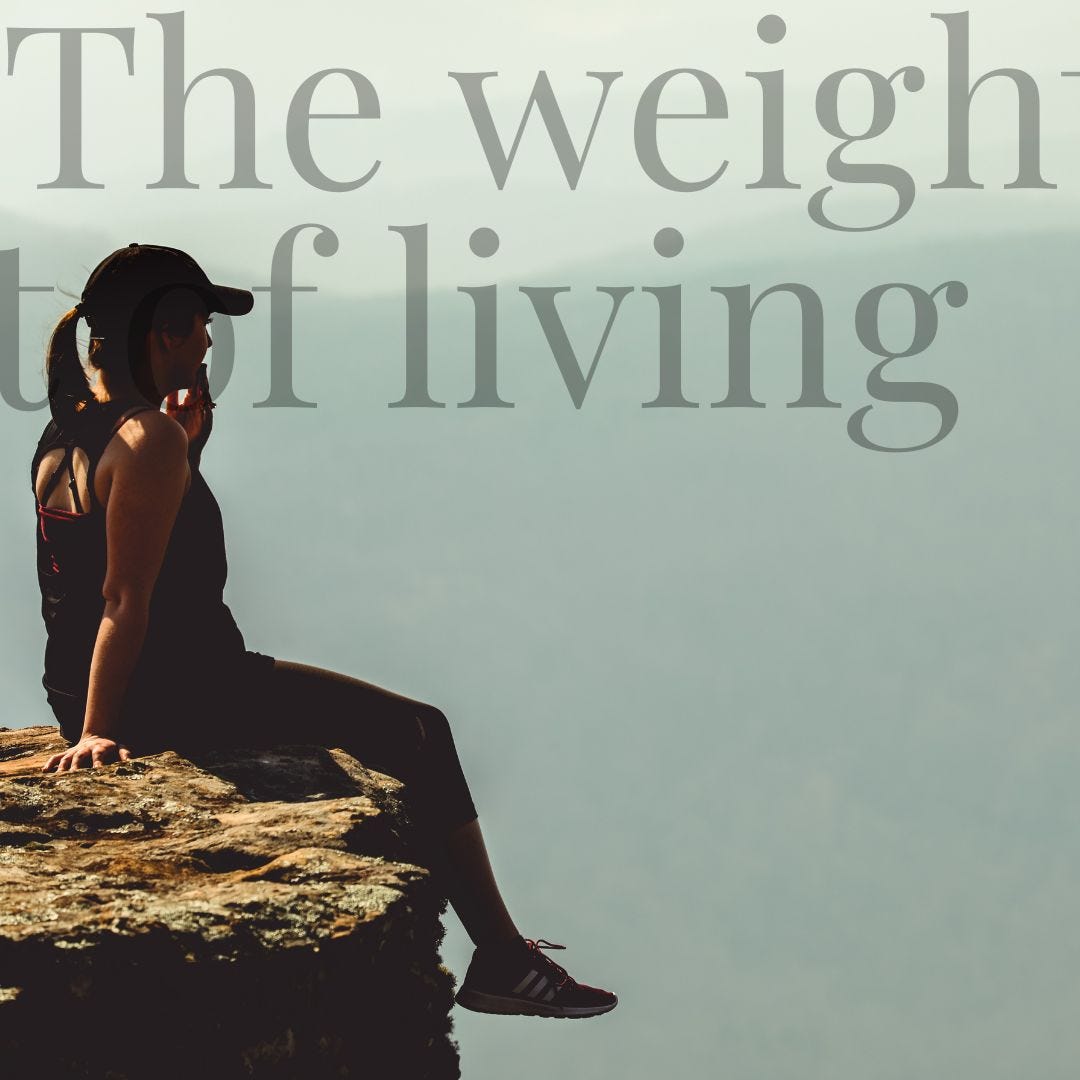
I overdid it, and now my nervous system is paying the price.
I spent the day yesterday helping one of my best friends put his store back together after they had the floors replaced. I’ve been working at his shop for a few hours a week since August, and I’ve been loving it. As an owner of three online businesses with a focus on writing and energy work, I spend a lot of time at home—in my head and supporting others. Which is great. I love my alone time, and I absolutely adore the work that I do. But I also needed to find some balance, and a few hours a week interacting with people and giving my body more of the physical movement it craves has been so helpful.
But it doesn’t come without its limits. Especially when you have chronic Lyme disease.
Living with chronic illness means living in constant negotiation with your body. There are moments when I feel energetically limitless—times when I surpass my own expectations and feel almost victorious in what I can handle. And then there are the consequences. Hours or days in recovery mode. A body that won’t cooperate. A nervous system that demands rest whether I want to give it or not.
I’ve learned to live like this. That’s what you do when you have a chronic illness—you adapt so that it becomes your new normal, and while it might look “normal” on the outside, it’s because you’ve gotten very, very good at managing your life.
I’m worlds away from where I used to be, and I’m so incredibly grateful for it. But I still get angry with myself—with my health and my body—for not being where I want to be.
And I don’t want to feel that way.
I don’t want to keep blaming myself when I’m at capacity. I don’t want to punish myself when I’m feeling limited. I don’t want to feel like I’m not doing enough when for the past few years, my sole focus has been on my health and I’ve been doing everything I can to support myself.
I’m tired. It’s not just the fatigue of illness, though.
I’m tired of carrying it all.
One of the biggest lessons that I learned through my Lyme disease journey was that I don’t have to shoulder the burdens of life, and I think I’m revisiting that lesson now.
When we try to carry it all, there’s a price we pay. But what’s the price we pay if we let it all go?
Yesterday, I reached my limit. I overdid it. I didn’t uphold my boundary with myself or respect my personal limitations. I kept telling myself I was fine and could do more because I wanted to. I wanted to finish the job. I wanted to support the small business I’m now a part of. I could have easily told my friend—who I’ve known since we were sixteen, so there’s never a need to hide how I’m feeling from him—that I couldn’t do anymore (and eventually I did), but I’m stubborn and insistent and probably a touch masochistic, if not a lot neurodivergent. That’s a self-discovery that has been especially eye-opening for me…
It wasn’t even the physical work that was my inevitable emotional downfall. Nor was it the fact that my adrenaline was already in overdrive trying to navigate the snowy conditions on the way to work, or the little moments of simple missteps or overcoming micro-obstacles—though it might have been a culmination of all of it.
It was really the fact that I was at capacity, and because I subtly betrayed and abandoned my own needs, my nervous system became dysregulated.
I went home. I took a nap. I woke up to my counterpart texting me that he had dropped something off for me, and I felt a combination of relieved that I wouldn’t now have to drive there to retrieve it, grateful for the thoughtfulness, and disappointed that I didn’t get to see him—and all at the same time, I was utterly incoherent and unable to articulate or express any of it due to the fatigue.
A few hours later, in the solitude of my bedroom, I had a silent meltdown.
Why is it that women, especially, feel like we need to carry the world on our shoulders when the world exhausts and overwhelms us, too? When did we become so conditioned to believing we have to be the glue that keeps our lives—and the lives of those around us—together? That it’s shameful to have needs and wants, that if we’re wanting to receive, too, we’re selfish, and that if we’re generous, we’re constantly expected to give more?
We know what we want or what needs to get done, but we have to ask a thousand times just to be seen or heard, so we learn to shut up and not need anything from anyone. We let ourselves receive support but then we’re called dependent—or worse—and so we learn to shut down and do it ourselves, then we’re lambasted for being hyper-independent. We express ourselves and are met with resistance, dismissal, or silence, so we learn to minimize our needs until they disappear altogether.
Nobody can shoulder what a modern woman has been conditioned to carry, and yet we do.
We call it strength, but our self-reliance is survival.
We learn to stay quiet to keep the peace, to carry what isn’t ours to hold, and then we wonder why we’re so tired when no one is asking us how heavy it’s been.
Or better yet, no one is offering to lighten the load.
This isn’t a denouncement of men. I have the most incredible, supportive men in my life who are growing examples of healthy masculinity, including my counterpart, who is unconsciously reflecting to me where I’ve been hyper-independent and showing me how to be more receptive in my feminine energy.
It’s the patriarchy. It’s damning to us all—men and women included.
In my book, “The Unity Code,” I wrote about distorted masculine leadership and the suppression of the feminine and how the patriarchy actually harms us all. That truth feels less theoretical now and more cellular. Patriarchy isn’t just history or politics—it lives in our nervous systems. It lives in over-functioning, in self-abandonment disguised as responsibility, in minds and bodies that don’t know how to rest without guilt.
Balance—true union—is never about replacing one hierarchy with another but about harmony. And when the feminine principle is neglected or abandoned, the cost is paid internally before it’s ever visible externally.
I can see the collective shift happening. Women like myself are setting stronger boundaries and becoming more self-loving. They’re refusing disrespect and turning towards community instead of sacrifice and martyrdom. I’ve done this too—slowly, imperfectly, but sincerely.
For the past decade, I’ve been consciously working on expanding my capacity within my nervous system by working through my traumas, beliefs, sense of self, and healing energetically. My own spiritual journey has guided me to enacting energetic and physical boundaries, learning to honor my own needs and wants as fair and valid, and setting new standards for the relationships in my life because the most important one is the one I first have with myself.
Still, it’s not easy when you care. It’s not easy when you’re deeply empathetic. It’s especially not easy when you’re a psychic intuitive and can see the threads of life unfolding—when you want the best timeline for the world and the people in your life.
But you can’t control the world. And you can’t control another’s journey.
All you can do is love.
Ah, but to the carer, it never feels like enough. And when you have actual physical responsibilities, it really isn’t enough.
I was on the phone with a friend last night, trying to process my emotions. This is where I tend to be hard on myself—I’m so blessed because I have so much physical and emotional support in my life, and yet I still feel overwhelmed. She reminded me how much I carry that I’m not even aware of, and I finally saw myself through a new lens.
I’m carrying my own emotional experiences—fears and struggles that I don’t really tell anyone because who would I tell and what good would that do? I take responsibility for myself and my emotions, I reason, and so I’ll work through it like I always do.
In writing. Sharing in my journals or my poetry or with hundreds of strangers on the internet because who will read these words anyway? Here, at least, I’m not asking for anything other than acknowledgement, as if that’s a burden itself on the people I love and who love me.
Isn’t that what we all want, at the end of the day? Just to be acknowledged? Just to be seen and heard and held in that space?
I’m also carrying so many—my parents, who are aging and all the emotions and physical responsibility that comes with that; my animals who depend on me…literally; my soul family, who I keep energetic watch over and hold in my heart; a multitude of friends, who are dealing with their own traumas and asking for prayers; my clients and community whose journeys I hold space for…
The list goes on.
The easy thing would be to say, “Nope. Not my responsibility.” And it’s not. I’m not responsible for an individual’s choices or actions, and I’ve let go of all of the energy of wanting to be, no matter which way it unfolds. But we are also, in a way, responsible for each other. I can’t simply ignore my parents or my furbabies or my friends. I can’t ignore the injustices in the world. As much as it’s “not my circus, not my monkeys,” you can’t help but want to help when you care.
I’ve spent so much of my life holding, carrying, translating, stabilizing—for myself and for others—that all I want is to be alone for a bit. To not be needed. To not be responsible for anything or anyone.
But that’s not being honest.
Because what I really want is to not have to be strong. I want to express these passing feelings, to receive without shame or repercussion, and to let someone else take care of me—for a day, for a moment. I imagine the little girl inside of me being tucked into bed, her hair smoothed back from her brow as a kiss is planted there—comfortingly, lovingly, securely. And I can drift off to a peaceful and restorative sleep, knowing that I’m held.
My nervous system is short circuiting. My nervous system practitioner would probably say that it’s just upgrading—that I’m at capacity and being asked to take care of myself and set new standards so that capacity can expand.
And I will. I’ve been here before. But in this moment, I’m tired of trying to save a life.
Especially when it’s my own.
Want more words?

Read my books!
Available at www.montourscity.com and www.susandawnspiritual.com